How to Use a Reading Journal for Personal Growth
Reading can change your life, but only if you remember and use what you read. Many of us finish a book, feel inspired for a day or two, and then forget most of it.
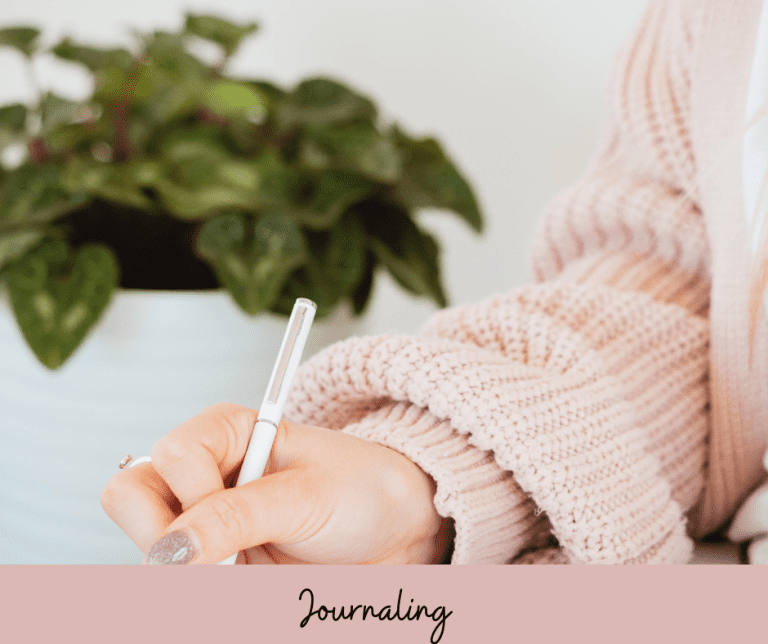
But once I started using a reading journal, everything changed. While I read the book, I sit down at my kitchen table and write down the most important parts.
This process has helped me slow down, think, and remember the lessons from the books I read.
If you’ve ever wished books “stuck” with you longer, a reading journal is one of the simplest tools you can start.
Why a reading journal changes everything
A reading journal is a safe place to write down what matters to you from a book. It can be a simple notebook or a notes app on your phone.
For me, the power comes from the pause it creates. This pause happens between reading a new idea and using that idea in your real life.
When I read a book I like, I take time to sit down and write down the most important insights. And when you write your thoughts, you understand the book better. You connect the ideas to your own life and challenges.
It becomes less about remembering facts. Instead, it is more about growing from what you read. That’s the real magic of a reading journal for personal growth.
What is a reading journal, and why it helps you grow
A reading journal is a notebook where you collect ideas, lessons, and thoughts from the books you read. It’s simple, but very powerful.
And it’s up to you to decide what information you want to include.
This kind of journal works especially well with self-help books. These books are full of insights, but most people forget them after a week.
Writing helps you hold on to what matters and use it in your real life.
What you should include in your reading journal
I always start with the basics. Then, depending on the book, I move on to include some of the following:
- The title of the book and the author’s name.
- The date when I read it.
- Main ideas and takeaways from the book.
- My personal thoughts about what I read.
- A list of actions I want to take.
When you write down quotes from the book, don’t try to copy everything. Just write what matters to you.
Also, try to add questions that the book brings up. Write down how you want to apply the lessons in your own life.
After a few months, these small notes will help you reflect. They will also remind you of why you found the book important.
Reading Journal vs. Book Summaries
A reading journal is deeply personal. It is where you write your own thoughts, favorite quotes, and reflections while reading. It is about what you take away.
A book summary is general. It gives a quick overview of the main ideas in the book. It’s meant to explain the book to someone who hasn’t read it yet. Your journal is just for you.
Benefits of Using a Reading Journal for Personal Growth
I started using my journal in 2025. After just a few months, I noticed many powerful benefits.
It helps me track my progress. I can look back at my old notes. I see how my thoughts and ideas have changed over time. It’s like following my own growth month by month.
I remember what I read. Before, I would finish a book and forget half of it quickly. Writing down the key ideas helps me actually remember and use them.
It deepens my understanding. When I pause to write my thoughts, the concepts sink in better. I connect them to my own life instead of just reading words.
It makes reading more intentional. I stop just flipping pages to reach the end. I start actively looking for lessons, ideas, and quotes that help me grow.
It keeps me consistent. A reading journal motivates me to read a little every day. Even when I am tired, writing one sentence keeps me moving forward.
It sparks self-reflection. Many books make you think about your habits, beliefs, and goals. Journaling turns those insights into real change.
What to Write in a Reading Journal
Keeping your reading journal simple
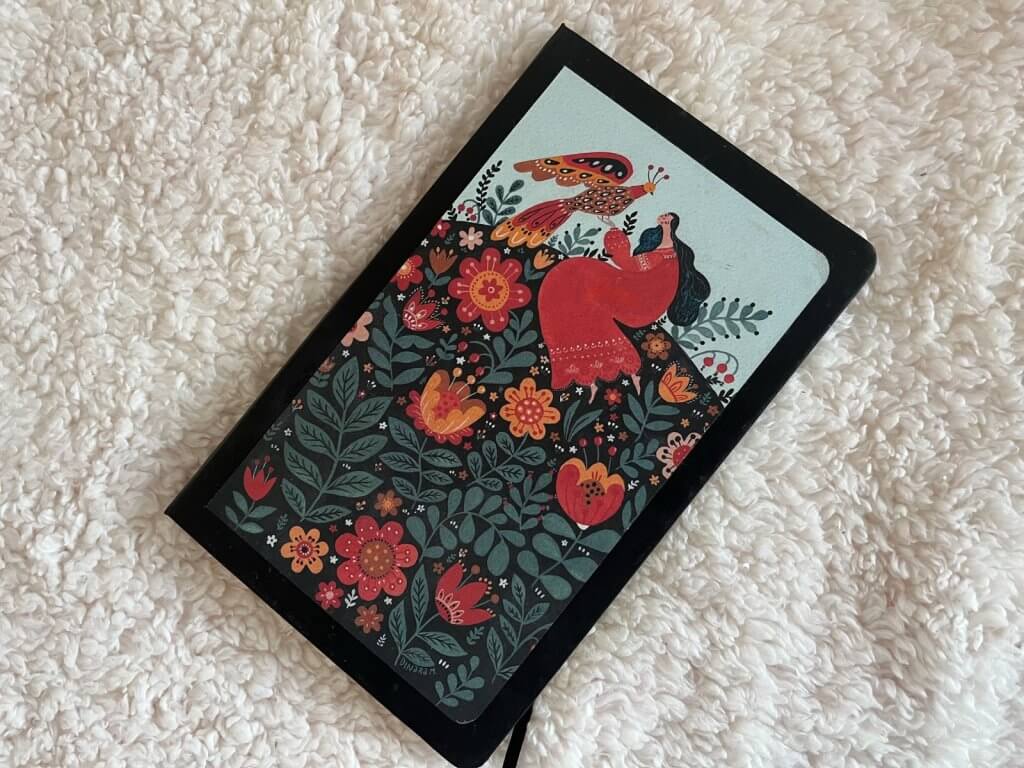
In my own reading journal, I keep things very simple. I have a list of books I want to read. I set aside a few pages for that list at the front or at the back of the notebook. I add titles there during the year.
Then, for each book, I write the title and the author. After that, I write down the main quotes and ideas from the book.
I like to write those quotes down while reading the book. This makes it feel like I am studying. It helps me remember much more from the book than I would have otherwise.
Items to Include for Personal Growth
Here are some specific things you can include in your reading journal for self-improvement:
- Key insights and quotes that make you stop reading.
- The main ideas of the chapter or the whole book.
- The questions the book makes you ask yourself about your life.
- Practical steps you want to try after reading.
- How the book relates to your current life challenges.
How to Set Up Your Reading Journal (Step-by-Step Guide)
Choosing the Right Journal
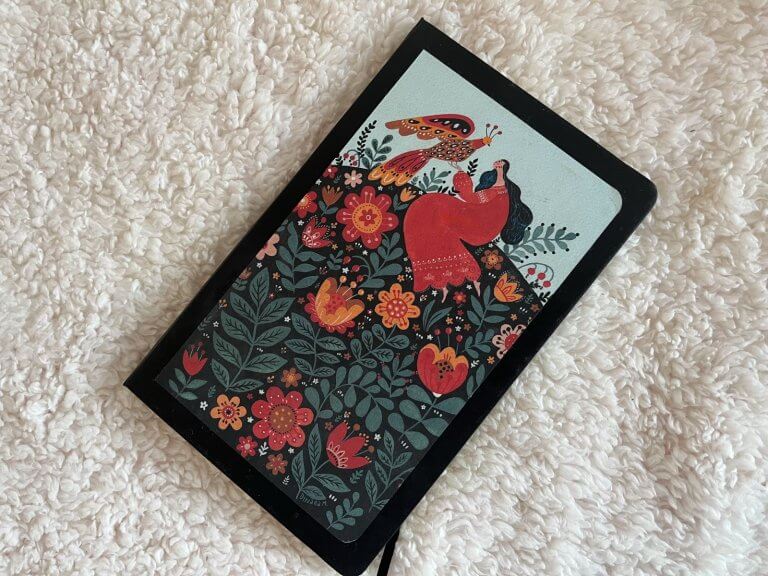
Setting up your reading journal is not hard. I use a simple notebook (I really like Moleskine) as I like the flexibility of being able to use a scalable number of pages for each book.
Sometimes I only write 2 pages, and sometimes I need 10. When I buy a guided reading journal, I am unable to change the number of pages I need.
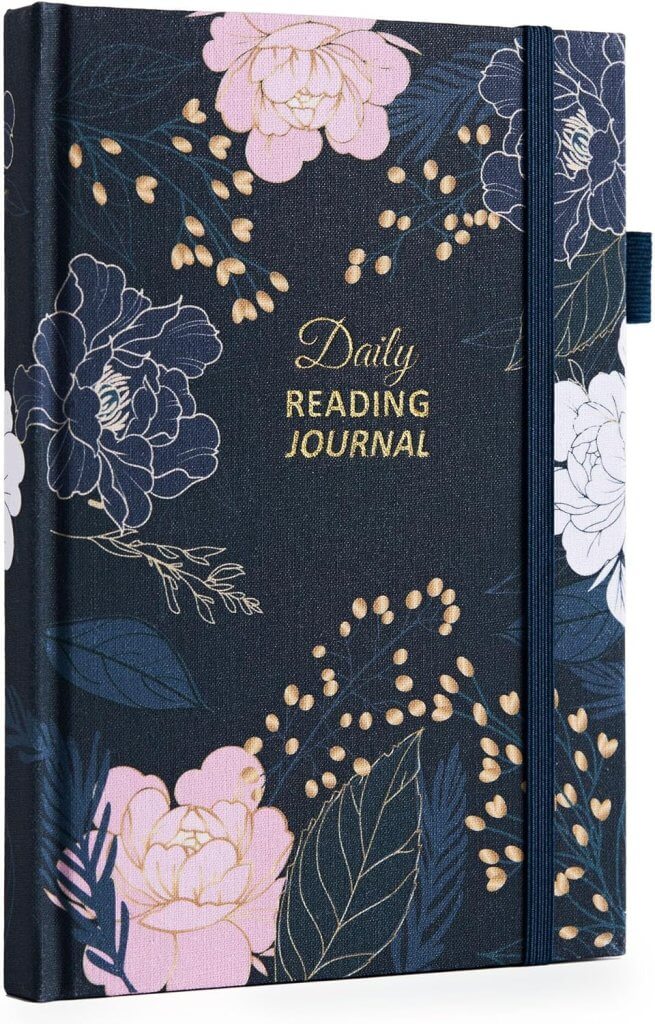
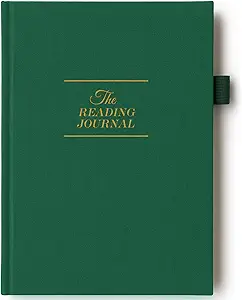
There are beautiful reading journals on Etsy and Amazon, but make sure to check how they look inside and consider how much text you would like to write.
Here are some nice examples you can check out on Amazon: JXSELECT Elegant Reading Journal and COMKISO store Reading Journal for Book Lovers.
Step-by-Step Guide for creating a reading journal
So here are some steps I follow when I start creating a new reading journal:
1. Choose the right format
- a plain notebook
- a digital document
- a notes app on your phone
- or a guided journal
You can pick a plain notebook, a digital document, a notes app on your phone, or a guided journal. Pick the format you know you will actually stick to. Consistency matters more than looks.
2. Start with a simple layout
The second step is to create a few basic sections for each book. You don’t need anything complicated at all.
Your core layout can be:
- Book Title + Author
- Date started / Date finished
- Key ideas or quotes
- Your thoughts & reflections
- How you will apply this
You don’t need anything more complicated.
In fact, I mostly write down the book title, author, date and then I write down quotes from the book.
In the end, I write a few paragraphs about what I think about the book, and I write down actionable steps I want to apply from it (if any).
3. Create a small ritual
Decide when you will journal.
For example:
- right after reading in the evening
- in the morning with your coffee
- during your weekend slow time
I really like to read in the afternoon after work. I put a cup of tea on my kitchen table and I sit down to read with my reading journal. As I read, I write down the quotes that I really like.
Sometimes I manage to do this for 10 minutes, and sometimes I can even dedicate an hour.
What matters is that I read every day, even if that means for a few minutes right before I fall asleep.
A tiny routine helps you stay consistent.
4. Capture the main idea in your own words
Instead of rewriting the book, write a short summary of what you understood.
This helps the ideas stick and forces your brain to process the message.
5. Write down the quotes that stay with you
When something hits you, pause and write it down.
These become anchors you can return to later.
6. Reflect on why the idea matters
Ask yourself simple questions:
- Why did this part stand out?
- How does this apply to my life right now?
- What does this make me rethink?
This is where personal growth happens.
7. End with one small action
Every book offers at least one practical tip. Write down one thing you can do in the next 24 hours to apply it. Remember, small actions lead to real change over time.
8. Review your journal once a month
Flip back through all your notes. You will be surprised by how much you have learned. You will also see how many ideas you forgot!
Reviewing helps you use the lessons in your life.
How to Use Your Reading Journal to Improve Your Life
This is now the most important part of your journey. To learn to use your reading journal in a way that will improve your life.
It is easy to read a lot of self-help books and feel excited, but what matters in the end is whether you apply what you learned in your own life.
When I read the Atomic Habits and wrote down the tips from the book in my Reading Journal, I immediately started implementing them the next day.
Not all tips at once, but little by little, I included tips from the book into my daily life and that led to one of the most transformative years of my life.
So here are some tips I do regularly to make sure I move from information to action:
Here are some tips I use regularly to move from just having information to taking action:
- Focus on Action: I write down the most important ideas from the book. I especially focus on those ideas I want to try and implement.
- Refresh Your Memory: I review my notes weekly or monthly. This helps me refresh my memory of the main lessons.
- Make it Fit: Modify the ideas from books so that they fit into your life. For example, I cannot get up at 5 am. So I modified the time to 6 am.
- Create a Core Lessons Page: Create a special “Lessons to Keep” page in your journal. Write down the major insights from books you want to be able to find and return to easily when needed.
Reading Journal Examples
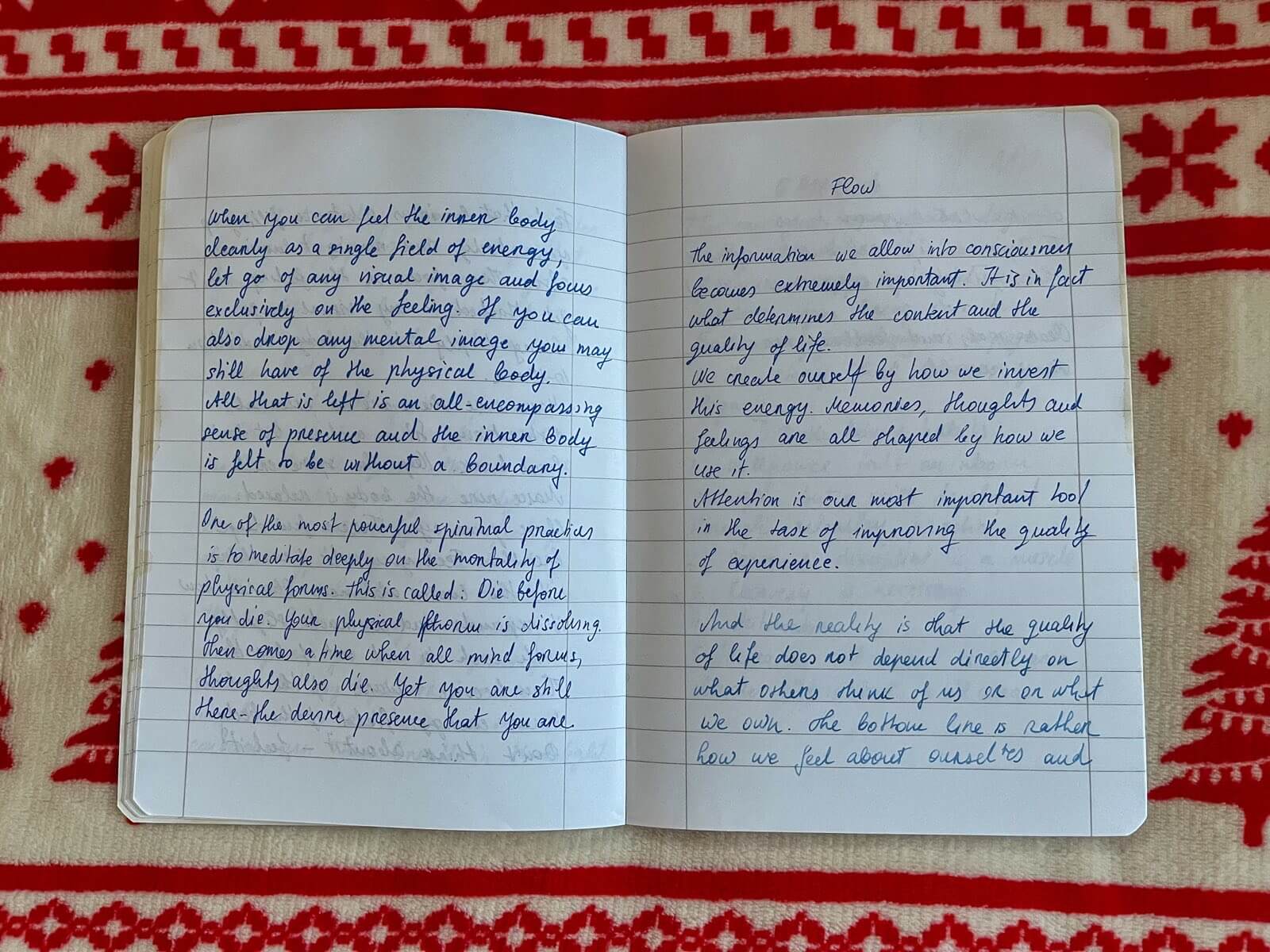
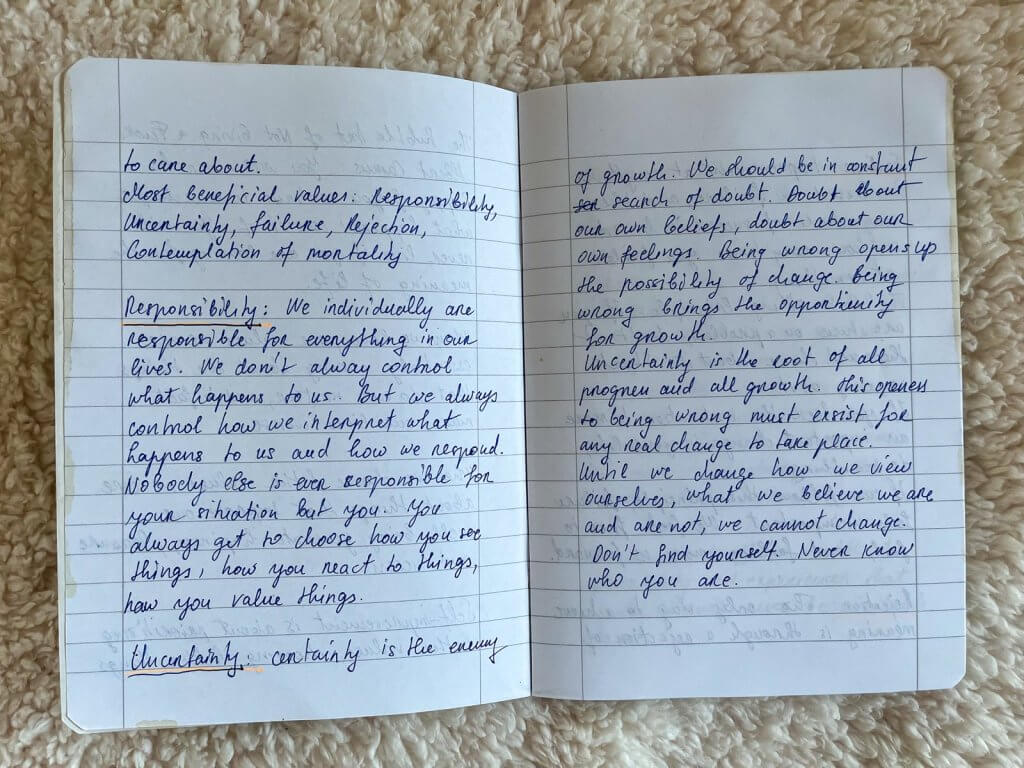
My reading journal is very simple and minimalistic. I don’t try to make it perfect or look aesthetic. I just write whatever I believe is important for me.
I would strongly suggest that any first-time journalers keep everything simple. You are creating a new habit. You do not want to overcomplicate your pages. It is far more important to actually use the journal than to make it look perfect.
Here is a visual idea of an example page from my journal:
Common Mistakes to Avoid
When you start using a reading journal, it’s easy to fall into a few traps. Here are the most common ones and how to avoid them.
Mistake 1: Overcomplicating your journal
You add too many sections, trackers, and special pages. Suddenly, your journal becomes a project instead of a tool.
The point isn’t to document everything; it’s to capture the ideas that actually matter. Keep it simple.
Mistake 2: Writing way too much
A reading journal isn’t a place to rewrite the book.
If you over-explain every chapter, the real insights get buried. Focus on clarity, not volume. A few sharp notes are more powerful than a page of rambling.
Mistake 3: Never reviewing your notes
Taking notes isn’t the goal, remembering is.
If you never revisit what you wrote, you lose the entire benefit of keeping a reading journal. Build a monthly or quarterly review habit so your notes actually guide your growth.
Mistake 4: Consuming books without applying anything
You read. You take notes. You even review them. But when it’s time to act, nothing changes.
Growth only happens when ideas turn into behavior.
If you struggle with this, check out my post How to Stop Procrastinating, it will help you bridge the gap between knowing and doing.
Best Self-Help Books to Start Your Reading Journal
You can use a reading journal for any type of book, but self-help books give you the biggest return. They’re filled with ideas you can apply immediately, which makes them perfect for your reading journal.
But you can use any type of book, as long as you feel that it contains ideas you want to remember and return to after a while.
Here are some great self-help books to start with:
- The Power of Now – A strong introduction to presence, awareness, and slowing down.
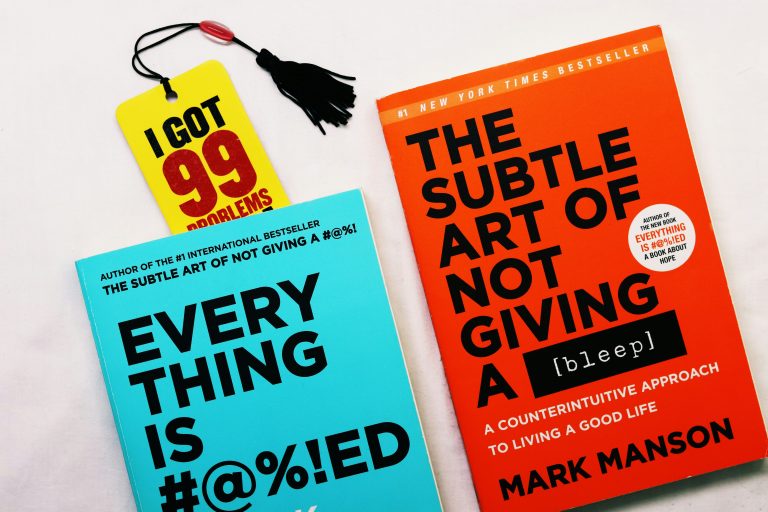
- The Subtle Art of Not Giving a F#ck – Helps you rethink priorities and let go of unnecessary pressure.
- The Mountain Is You – A powerful book for understanding self-sabotage and building emotional resilience.
If you want more ideas, I often share reviews and curated lists. These two posts will help you find your next read:
Personal Growth Books for Beginners
Final Thoughts: Start with One Book
Like any new habit, the most important thing is to start. Your reading journal doesn’t need to be perfect. It doesn’t need to be aesthetic. It just needs to be used.
You can write a lot or a little. What matters is consistency.
So what’s the best book to begin with? The one you’re reading right now.
Open your notebook, write down the ideas that stand out, and let that be enough to get you going.
Related posts
6 best journaling methods for beginners