The 5 AM Club vs The Miracle Morning: My Experience
The way we start the day is one of the most important decisions we make. It sounds dramatic, but it is true.
With the right routine, we make progress every single day.
With the wrong one, we wake up stressed and in a hurry, and start the day already feeling behind.
I started reading books about morning routines because they are highly motivating and I wanted to change both my daily habits and my mindset.
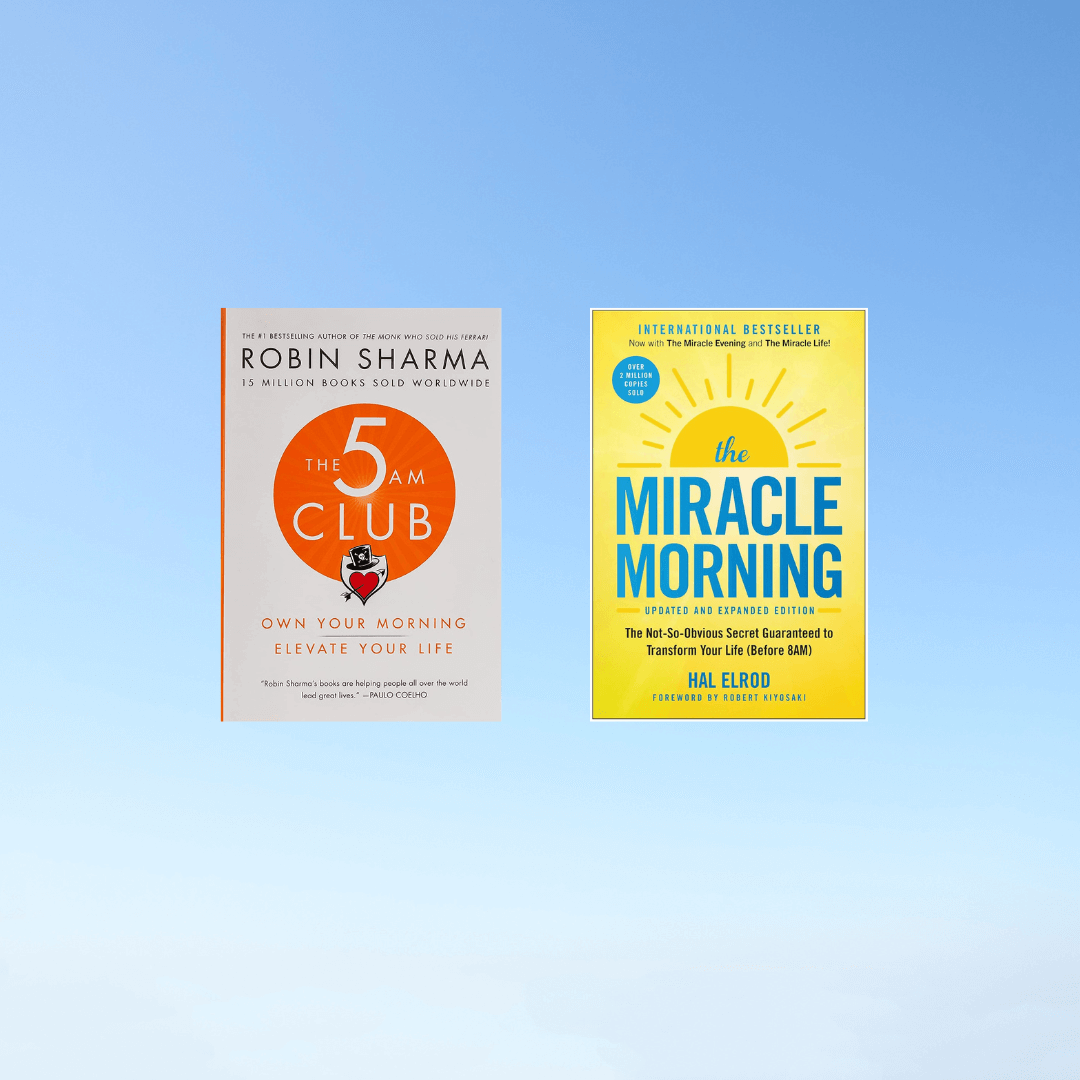
There are two most popular books at the moment, The Miracle Morning and The 5am Club.
I posted my reviews for both of these books earlier. You can read the reviews here:
- The 5am Club by Robin Sharma
- The Miracle Morning by Hal Elrod
These books are very similar in theory (waking up early will change your life), but very different in the writing style and the approach. So I thought it would be good to share a comparison of the two and tell you which one I liked the most.
What Is The 5 AM Club?
Take excellent care of the front end of your day, and the rest of your day will pretty much take care of itself.
Robin Sharma
The 5AM Club by Robin Sharma uses a fictional story about two struggling strangers and an eccentric tycoon to deliver its self-development message.
The style is different from everything I read before, so beware of this. Yet, the advice in the book is valid so I continued reading it and finished it in a couple of days.
The idea is this: You wake up an hour before your spouse and your kids and use that distraction-free time to focus on your personal well-being, with a mix of exercise, meditation and reading or learning.
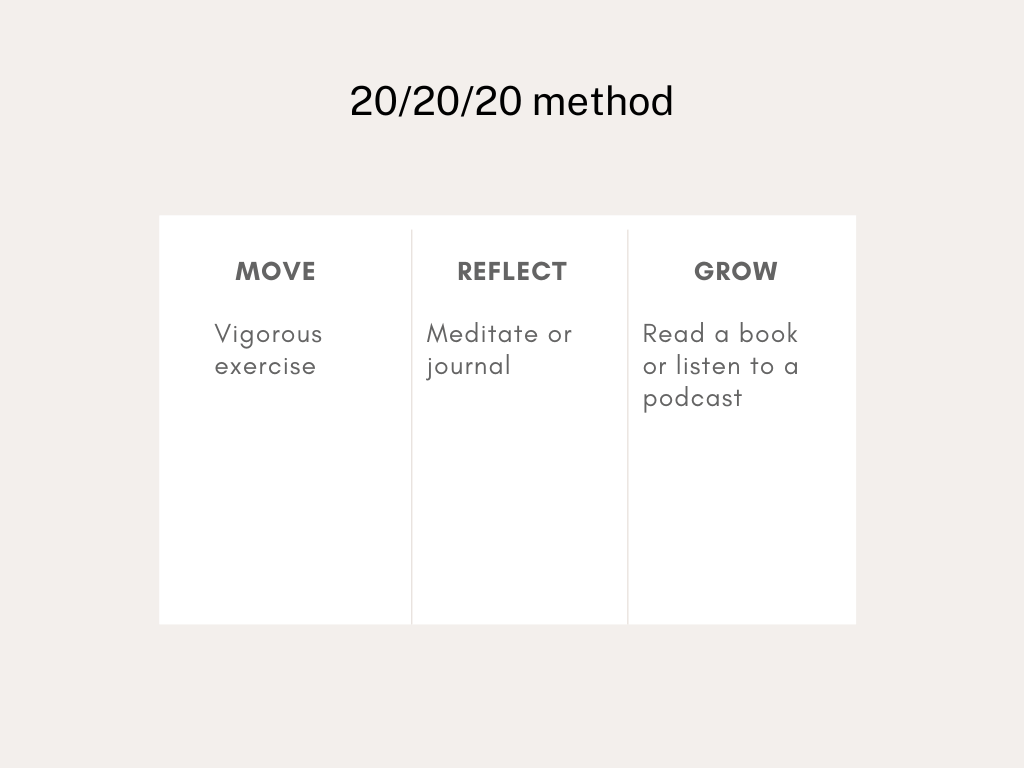
When you wake up at 5am, you need to implement the 20/20/20 formula:
My experience trying the 5am routine
I have to admit that I never fully tested this routine as it was originally intended. With two small kids, getting up at 5 a.m. simply wasn’t realistic for me, so I shifted it to 5:30 or 6 a.m.
That said, I did fully implement the 20/20/20 method, and I found this structure to be almost perfect. You get 20 minutes of exercise, 20 minutes of meditation, and 20 minutes of reading or journaling.
Nothing feels too long or overwhelming, which makes it easy to stick with long term. I’m not rigid about it either, some mornings I exercise longer, other days I read more.
But overall, I aim to do all three most mornings, and they work incredibly well together. The structure is simple, not complicated, and finishing exercise that early in the day is truly game-changing.
Strengths
The 5am Club is highly motivational and can genuinely inspire you to make a change. The writing style is simple, with no complex language or structure, which makes the book easy to read and possible to finish in just a few days.
Potential downsides
The main downside is the rigid wake-up time, which may not fit every life stage. With small kids, getting up at 5 a.m. doesn’t always work.
You may also struggle to go to bed early enough in the evening, depending on your work hours or your children’s schedules.
Another downside for me was the writing style. I didn’t truly enjoy the storytelling approach of the book. When it comes to self-help, I prefer a more traditional, straightforward non-fiction style.
What Is The Miracle Morning?
Your level of success will rarely exceed your level of personal development, and success is something you attract by the person you become.
Hal Elrod
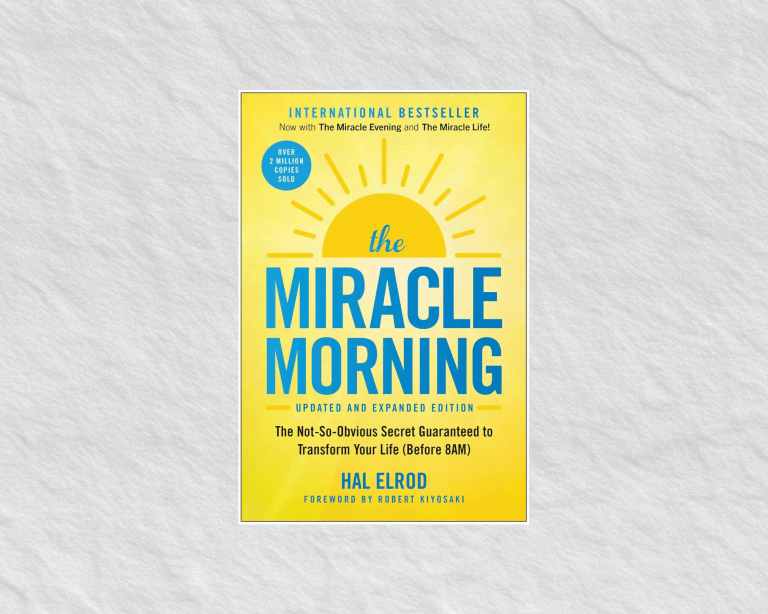
The Miracle Morning is a book by Hal Elrod. It is not a difficult book to read and you can do it in just a couple of days.
In this one, you do not need to start your day at 5 am, you can start it at 6 or 7. The point is that you get up early enough to have an hour or two for yourself.
When you get up, Hal proposes a SAVERS framework, which is basically this:
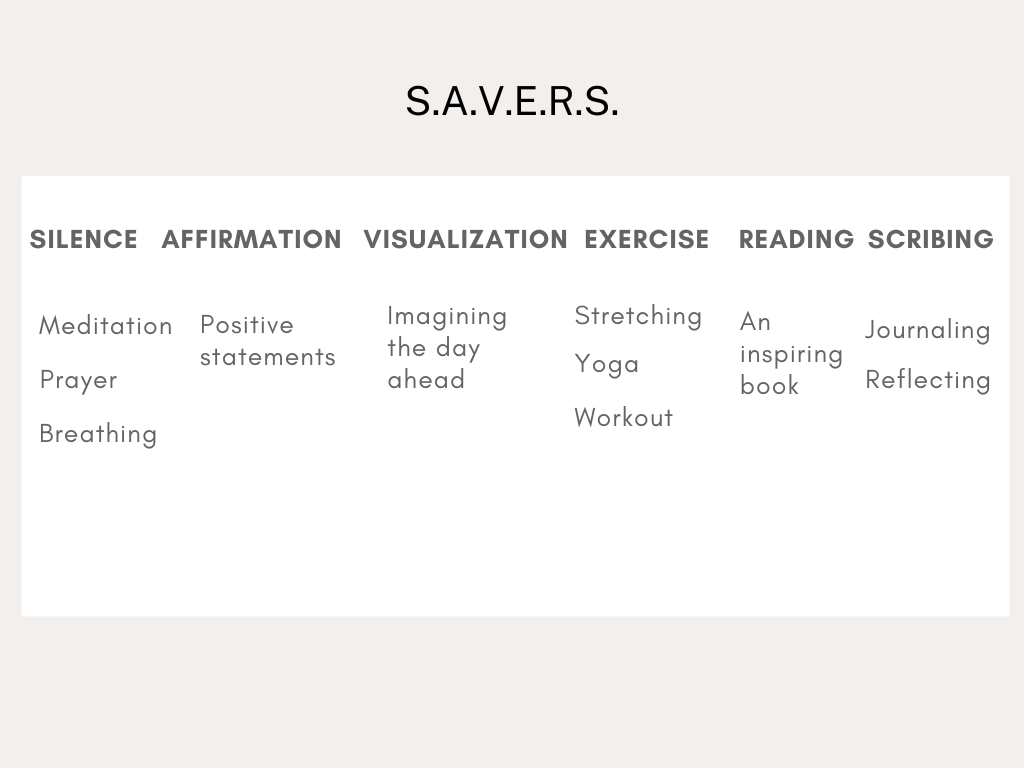
So you can see now that these books are very similar in their message. In this one, Hal Elrod believes you should use your mornings to feel better and get better.
And indeed this would be a perfect routine. The one where we manage to do both meditation, affirmation, visualization, exercise, reading and writing.
Strengths
I really like that the timing is flexible. It doesn’t make you feel like a failure if you can only get up at 7 a.m.
He also stresses the importance of sleep, which I think is crucial. We shouldn’t cut back on sleep just to squeeze in a routine. Sleep is essential for our health, wellbeing, and immunity, and no morning practice should come at the expense of that.
The routine itself is also customizable. You can do all six activities, or just focus on a couple of them. And if you only have half an hour in the morning, he suggests doing just a few minutes of each.
I really loved this message: do the best you can with the time and energy you have, however small that effort might feel. Because over time, it all adds up.
Potential downsides
At first, this routine might overwhelm you, especially if you are used to simple mornings: drinking your coffee and scrolling your phone.
And I too find meditation, affirmations, or visualization a bit hard to do and include in my everyday routine.
The 5 AM Club vs The Miracle Morning: key differences
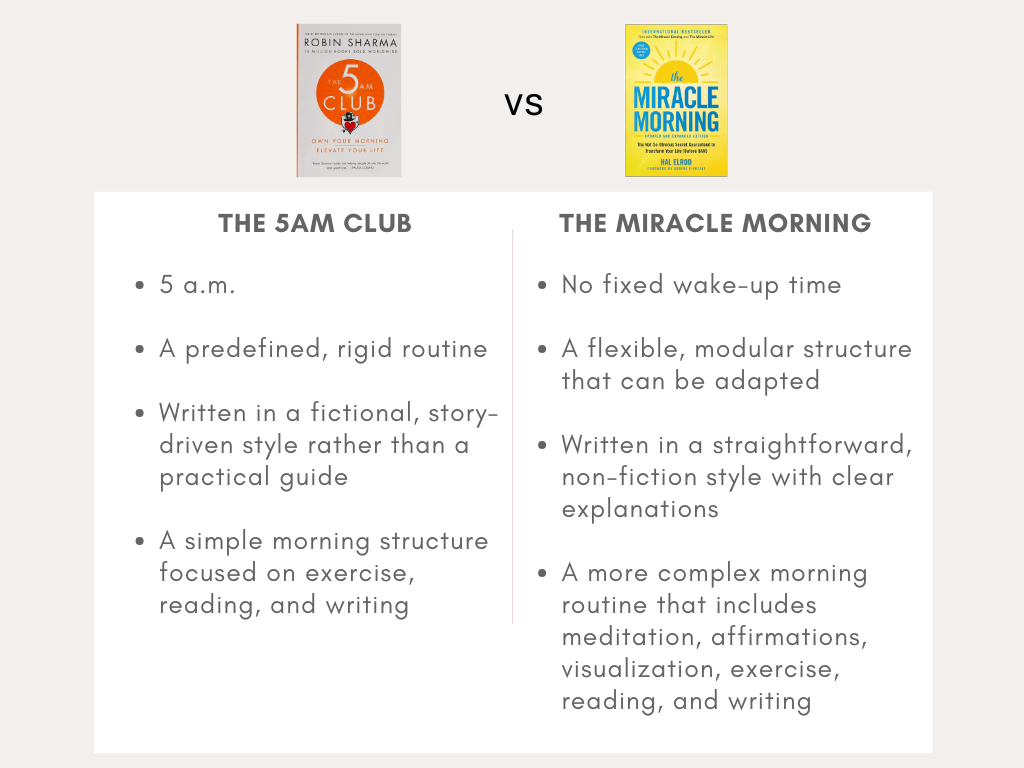
Which one is easier to stick with long term?
My honest answer is: neither.
Some people don’t mind getting up at 5 am, and if you live alone and don’t have kids, it’s definitely worth trying.
But if you’re in a different life stage, it makes much more sense to create a routine of your own, one that actually fits your lifestyle. That’s the only kind of routine you can realistically stick with long term.
Start small. Trying to change everything at once rarely works. Move your wake-up time gradually, and introduce habits like exercise, reading, and journaling one by one.
A six-step morning routine implemented all at once might look good on paper, but for most people it’s difficult to sustain over time.
The real goal isn’t to follow a routine perfectly for a few weeks and then give up. It’s to build something you can keep doing for years, or even for the rest of your life.
The book Atomic Habits really helped me understand why I kept failing when trying to introduce new habits, and what I needed to change in order to stay consistent.
My personal take
When I finished reading the second book, it became clear which one I preferred.
I found the style of The 5 AM Club a bit too cheesy and dramatic for my taste, and I enjoyed reading The Miracle Morning much more. That said, I do appreciate the simplicity of the morning routine in The 5 AM Club, and I genuinely enjoyed following it last year.
What I’m doing now is a combination of both approaches. I don’t wake up at 5 a.m., but I keep the simple three-step structure: exercise, reading, and journaling.
Trying to focus on six different elements first thing in the morning isn’t easy, and for many people, it may be difficult to sustain long term.
Final thoughts
Having tried both morning routines, I now see these books as guidelines rather than rules. The most effective routine is the one you build for yourself, the one that fits your life and that you can repeat consistently for years.
As books, I personally prefer The Miracle Morning. I find the writing style clearer and the message easier to follow.
So if you’re looking for a book about building a morning routine, that’s the one I’d recommend starting with.
Related posts
Book review: The Psychology of Money